OSHA jobsite toilet requirements, explained in plain English
OSHA jobsite toilet requirements come from 29 CFR 1926.51 for construction and 1928.110 for farm field crews. This guide explains the counts in plain words, so you can order the right units. Confirm site details with your safety officer or OSHA.
- Delivery area
Jobsite units across Beaufort County and the Lowcountry, plus weekly service routes statewide. Check your ZIP.
- Arrival
Same-day Monday–Saturday when you call by noon in Beaufort County. Most jobsite units land the day the crew starts.
- Right unit
1 toilet for 20 or fewer workers; 1 seat and 1 urinal per 40 above that. Add hand wash stations for paint or concrete work.
- Cleaning
Weekly pump-out, wash-down, disinfecting and restock included. Twice-weekly service for big or summer crews.
- Full cost
About $200–$290 per 28-day cycle plus a one-time delivery and pickup fee, all on one itemized quote.
Dispatch answers Monday to Saturday, 7 AM to 7 PM. A phone quote takes about five minutes.
Reviewed October 2026 by Austin, owner of Austin Rental Works
Enter your ZIP to see delivery timing for your address.
How many toilets does OSHA require on a jobsite?
OSHA requires 1 toilet for a jobsite with 20 or fewer workers under 29 CFR 1926.51(c), Table D-1. Jobsites with 20 or more workers need 1 toilet seat and 1 urinal per 40 workers. Jobsites with 200 or more workers need 1 toilet seat and 1 urinal per 50 workers.
| Number of workers | Minimum facilities | Example |
|---|---|---|
| 20 or fewer | 1 toilet | A 6-person framing crew: 1 unit |
| 20 to 199 | 1 toilet seat + 1 urinal per 40 workers | 75 workers ÷ 40 = 1.9, so 2 seats + 2 urinals |
| 200 or more | 1 toilet seat + 1 urinal per 50 workers | 260 workers ÷ 50 = 5.2, so 6 seats + 6 urinals |
Read the full text in OSHA 29 CFR 1926.51. A standard unit holds one seat and one urinal. Use our porta potty calculator to run your crew size.
Need units on site before an inspection? Call by noon and most Beaufort County jobsites get delivery the same day.
Call now for same-day(843) 268-6920Do mobile crews and short jobs need a porta potty?
Mobile crews are exempt from the 1926.51(c) toilet rule only when the crew has transportation readily available to nearby toilets. Under temporary field conditions, OSHA still says at least 1 toilet must be available. A 2-day remote job with no restroom nearby still needs a toilet on site.
Mobile crews
Utility, survey and landscaping crews that move all day may rely on nearby restrooms, but only if a truck is on hand to get there. Store owners don't have to let crews in, so many companies keep a unit at the yard or staging area.
Remote or short jobs
Fence lines, marsh docks and rural lots often have nothing nearby. Under 1926.51(c)(2), at least 1 toilet facility must be available, even on short temporary jobs.
No sewer on site
Job sites without a sanitary sewer use chemical toilets, recirculating toilets, combustion toilets or privies, unless local codes say no. A standard porta potty is a chemical toilet.
Ask first
These are plain summaries, not legal advice. Your safety officer or OSHA can tell you how the rule applies to your crew.
What does OSHA 1926.51(f) say about handwashing?
OSHA 1926.51(f) requires adequate washing facilities near the work when crews apply paint, coatings, herbicides or insecticides, or handle other harmful contaminants. Lavatories with soap and towels must also be available, except for mobile crews with ready transportation. Ask your safety officer how your site meets 1926.51(f) for your trades.
- Paint, coatings and chemicals. Washing facilities must sit near the work and let workers remove the substance.
- Soap and towels. The lavatory rule calls for hand soap and individual towels or air blowers.
- Concrete and mortar. Wet cement is hard on skin; many contractors add a wash station for masons.
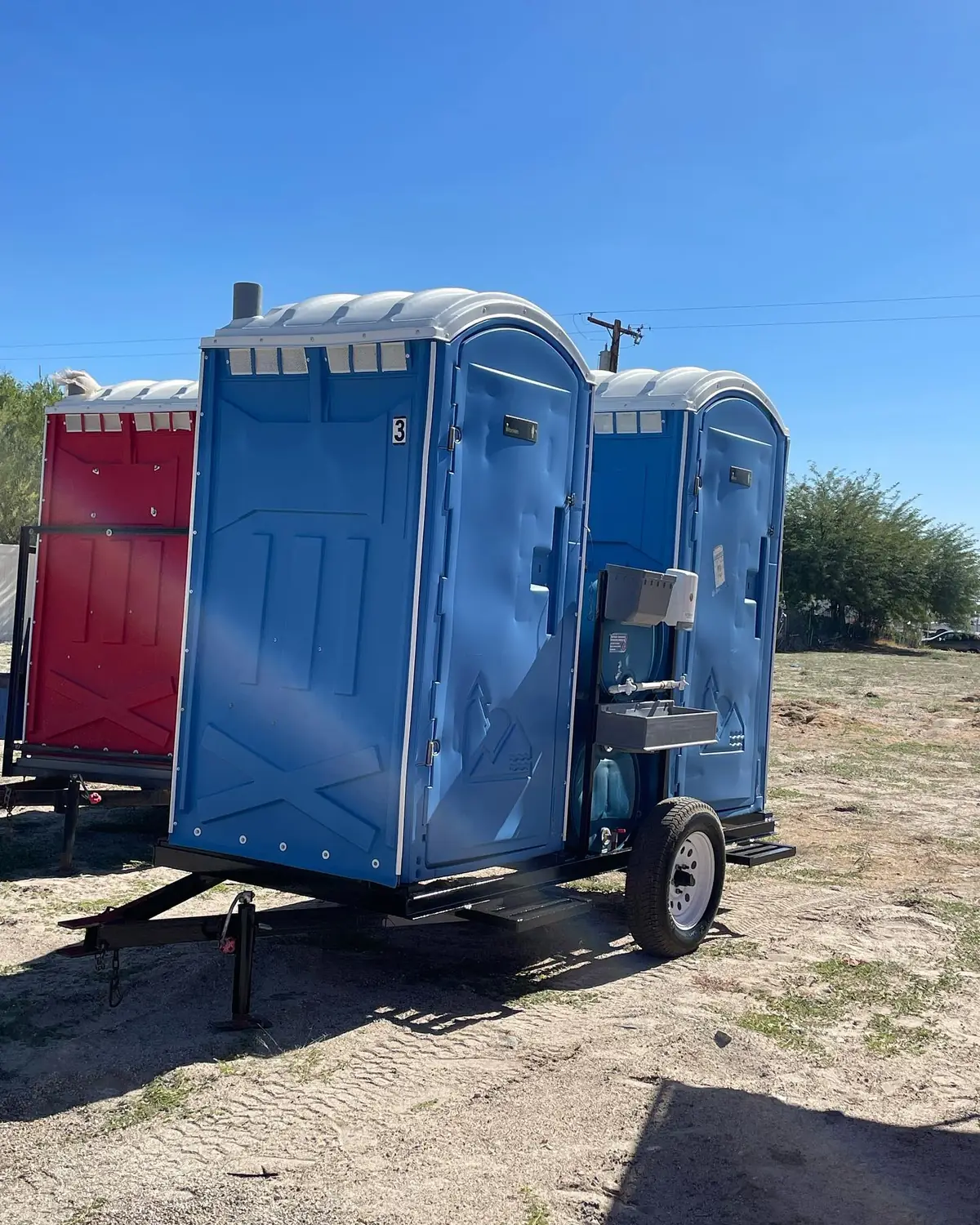
- Our hand wash station. 2 foot-pump sinks, soap and towels, good for about 400 washes per fill.
See the portable hand wash station we deliver with jobsite toilets.
What are the OSHA toilet rules for farm field crews?
OSHA 1928.110 applies when 11 or more workers do hand labor in the field on a given day. Farms must provide 1 toilet and 1 handwashing facility for each 20 workers or fraction, within a one-quarter-mile walk. Field work of 3 hours or less, including travel, is exempt from that toilet rule.
| Rule | What it says |
|---|---|
| Who it covers | 11 or more hand laborers in the field on a given day |
| Count | 1 toilet + 1 handwashing facility per 20 workers or fraction (21 workers = 2 of each) |
| Distance | Within a one-quarter-mile walk of each worker |
| Rough terrain | At the closest point vehicles can reach |
| Short shifts | Not required for field work of 3 hours or less, travel included |
| Upkeep | Toilets kept operational, clean and sanitary |
Read the full field sanitation rule at OSHA 29 CFR 1928.110. Harvest and packing crews on monthly units get the same weekly service as jobsites.
Do men and women need separate jobsite toilets?
Separate toilets for men and women are not needed when each toilet holds 1 person at a time, locks from the inside and has a toilet seat. That wording comes from OSHA's general industry rule, 29 CFR 1910.141. A standard porta potty fits that description. Confirm the rule for your site with your safety officer.
The count still follows Table D-1, so mixed crews share the same number of units. For larger crews, some contractors label one unit for women. Read the wording in OSHA 29 CFR 1910.141.
How does weekly service keep a jobsite toilet usable?
Weekly service keeps a jobsite toilet usable by pumping the tank, washing and disinfecting the unit, adding deodorizer and restocking paper and sanitizer. A standard unit is rated around 200 uses between services. Crews of 11–20 on 40-hour weeks, or summer crews, often need twice-weekly service to stay ahead of a full tank.
- Keep the rental agreement. The e-signed agreement shows unit count, delivery date and service schedule.
- Log the crew size. Note the peak headcount each week and match it to Table D-1.
- Track service visits. Keep a note of each weekly pump-out date with the site paperwork.
- Add units as the crew grows. Crossing 20 workers, or 40, changes the count. Call when trades stack up.
- Show where facilities are. Tell each new worker where toilets and hand wash stations sit.
Monthly units bill on a 28-day cycle with weekly service included. See construction site toilet rentals for setup and placement.
Questions customers ask
How many porta potties does OSHA require for 25 workers?
OSHA Table D-1 calls for 1 toilet seat and 1 urinal per 40 workers once a crew passes 20. A 25-person crew needs 1 seat and 1 urinal, which a standard unit has. Many crews that size add a second unit for shorter lines.
Does a two-day job really need a porta potty?
A two-day job still needs a toilet available under OSHA's temporary field conditions rule. The exception is a mobile crew with transportation readily available to nearby toilets. Confirm with your safety officer if the crew fits that exception.
Is a gas station restroom enough for my crew?
A gas station restroom counts only if the crew is mobile and has a vehicle ready to drive there. The business also has to let your crew use it. Many contractors keep a unit on site so work doesn't stop.
Does OSHA say how often a jobsite toilet must be cleaned?
OSHA's construction rule sets the count, and the farm rule says toilets must stay clean and sanitary. Our jobsite rentals include weekly pump-out, wash-down, disinfecting and restock. Twice-weekly service is available for big or summer crews.
Do farm workers picking for a few hours need a toilet?
Farm field work of 3 hours or less in a day, including travel to the field, is exempt under OSHA 1928.110. Longer shifts with 11 or more hand laborers need 1 toilet and 1 handwashing facility per 20 workers.
Does OSHA require a hand wash station with the porta potty?
OSHA 1926.51(f) requires washing facilities near the work when crews handle paint, coatings, herbicides, insecticides or other harmful contaminants. Lavatories with soap and towels are also part of the rule. Ask your safety officer how your site meets it.
Can subcontractors share the general contractor's units?
Subcontractors can share the general contractor's units when the total crew on site matches the Table D-1 count. Count every worker on site on the busiest day, not just your own crew.
What should I keep on file for a jobsite inspection?
Keep the rental agreement, the unit count, the peak crew size and the weekly service dates. Those 4 records show the count matched the crew. Your safety officer may want more, so ask what the company policy covers.
Get a written quote
Five details and we call or text back with one full price: rent, delivery, pickup and tax.
Faster by phone
(843) 268-6920- Locally owned, our own units and trucks
- Same-day delivery Monday to Saturday
- Every fee on the quote before you book
- Weekly service on jobsite rentals
Web quotes get a call back within 30 minutes during business hours.
Get jobsite toilets that match your crew
Call with your crew size and start date, and we set the unit count, service day and full price.
- Same-day deliveryCall by noon, Mon–Sat
- Locally ownedOur own units and trucks
- Cleaned weeklyOn every jobsite unit
- No hidden feesOne itemized total